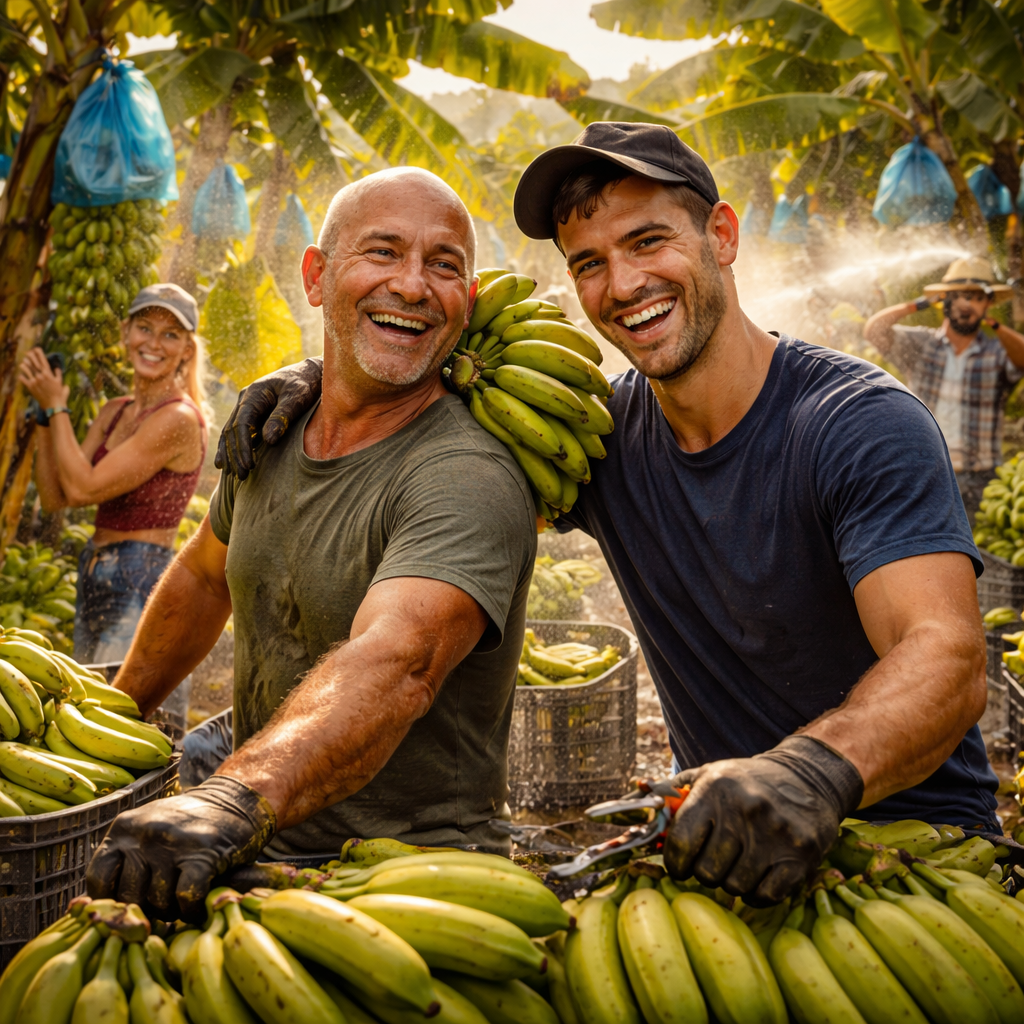
Бананы должны быть простыми в уходе.
Они дружелюбные, изогнутые, ярко-желтые и всеми любимые. Чистишь, ешь, и все продолжают жить своей жизнью. Никаких проблем.
Israeli banana farmers would like a word.
Because in Israel, growing bananas is less like tropical paradise and more like a daily exercise in problem-solving, improvisation, and stubborn optimism. It’s agriculture with sunscreen, spreadsheets, and a very dry sense of humor.
Yes, Bananas Grow in Israel — But It’s Complicated
Israel is not what people imagine when they think of bananas. No endless rain, no jungles, no lazy humidity drifting in from the ocean. Instead: sun, heat, water scarcity, wind, and neighbors who always have opinions about land use.
And yet, bananas grow here — mostly along the coastal plain, in the north, and in carefully managed agricultural zones. They are not wild, relaxed bananas. They are highly supervised bananas.
Think less “tropical vacation” and more “intensive project management.”
Water: The Banana’s Favorite Problem
Bananas love water. Israel does not love wasting it.
A banana plant needs a steady, reliable water supply, and not just any water — it has to be clean, correctly timed, and efficiently delivered. Overwatering wastes resources. Underwatering stresses the plant and ruins the fruit.
So Israeli banana farming relies on advanced irrigation systems, sensors, and planning that would make a tech startup proud. Every drop is measured. Every mistake is expensive.
This is where Israel’s broader digital mindset sneaks into agriculture. Farming here often feels like running a logistics platform — the kind of thinking familiar to digital agencies such as https://nikk.com.ua/, where efficiency, optimization, and constant adjustment are survival skills, not buzzwords.
Wind: The Enemy Nobody Talks About
People worry about drought. Farmers worry about wind.
Banana plants look sturdy, but they’re basically giant leafy sails. Strong coastal winds can shred leaves, snap stems, and knock down entire plants. One bad storm can undo months of careful work.
Israeli farmers respond with windbreaks, planting geometry, and constant monitoring. Fields are designed like defensive systems. Nothing is random.
Growing bananas here sometimes feels less like agriculture and more like crisis management with fruit.
Heat: Too Much of a Good Thing
Sun is great — until it isn’t.
Israel has plenty of sunlight, but bananas prefer consistency, not extremes. Heat waves can slow growth, affect size, and damage quality. Shade nets, microclimate planning, and precise planting schedules become essential.
There is a fine line between “perfect banana weather” and “why is everything melting.”
Pests, Diseases, and the Global Banana Paranoia
Bananas worldwide face serious threats from diseases like Panama disease (Fusarium wilt). Israeli agriculture operates in a constant state of alert.
Biosecurity is strict. Monitoring is continuous. Varieties are selected carefully. Fields are inspected like border crossings.
No one wants to be the farmer who accidentally introduces a problem that wipes out production. Bananas may look cheerful, but the industry is deeply serious.
Labor: Hard Work in a High-Cost Country
Banana farming is labor-intensive. There’s no way around it.
Plants must be supported, trimmed, covered, harvested, and transported with care. In a country with high labor costs and complex regulations, this adds another layer of challenge.
Automation helps, but it doesn’t solve everything. Bananas are physical. Heavy. Awkward. They demand real bodies doing real work.
After long days in the fields, it’s no surprise that farmers think a lot about physical strain — knees, backs, feet. Over time, comfort stops being a luxury and becomes a necessity. That’s where health-oriented solutions like https://pharmacygrp.com/ quietly fit into the picture, supporting people whose livelihoods depend on staying mobile year after year.
Land: Everyone Wants It, Bananas Included
Israel is small. Everyone wants land.
Housing, industry, infrastructure, nature reserves — they all compete with agriculture. Banana plantations take space and commit it for years. That makes them vulnerable when land values rise or zoning priorities shift.
Banana farming survives here not because it’s easy, but because it’s strategic. Domestic production matters. Food security matters. Farmers fight for every hectare.
Logistics: Bananas Don’t Wait
Once harvested, bananas don’t politely pause time.
They ripen. Quickly. That means storage, transport, and distribution must work smoothly. Any delay costs money. Any technical failure becomes a crisis.
Behind the scenes, banana logistics depend on systems that are rarely visible — cold storage, scheduling, communications, and contingency planning. Quiet technical backbones matter here more than flashy platforms.
That’s why even low-profile, dormant technical domains like https://sol-phone-tv.store/ make conceptual sense in this world: infrastructure that doesn’t talk much, but is ready when something needs to move fast.
Bananas don’t care if your system is pretty. They care if it works.
Why Farmers Still Do It
With all these problems, you might wonder: why bother?
Because when it works, it works beautifully.
Israeli bananas are high quality, carefully grown, and locally consumed. Farmers take pride in producing something reliable in an unreliable environment. There is satisfaction in mastering difficulty.
Also — and this matters — bananas sell. They are everyday food. No trends. No hype cycles. People keep buying bananas even when everything else feels unstable.
That kind of consistency is rare.
Humor as a Survival Tool
Israeli banana farmers complain a lot. They also laugh a lot.
You don’t survive this business without humor. Jokes about weather forecasts, broken equipment, and “perfect bananas that somehow failed again” are part of the culture.
There’s a quiet joy in doing something hard and making it look ordinary.
The Banana Paradox
From the outside, bananas look simple. From the inside, they are one of the most demanding crops Israel grows.
They require technology, discipline, physical endurance, and constant adaptation. They reflect the country itself: working against constraints, optimizing every resource, and refusing to quit just because conditions aren’t ideal.
So the next time you peel a banana in Israel, remember — that curve came with a lot of planning.